.jpg?w=600&h=600)

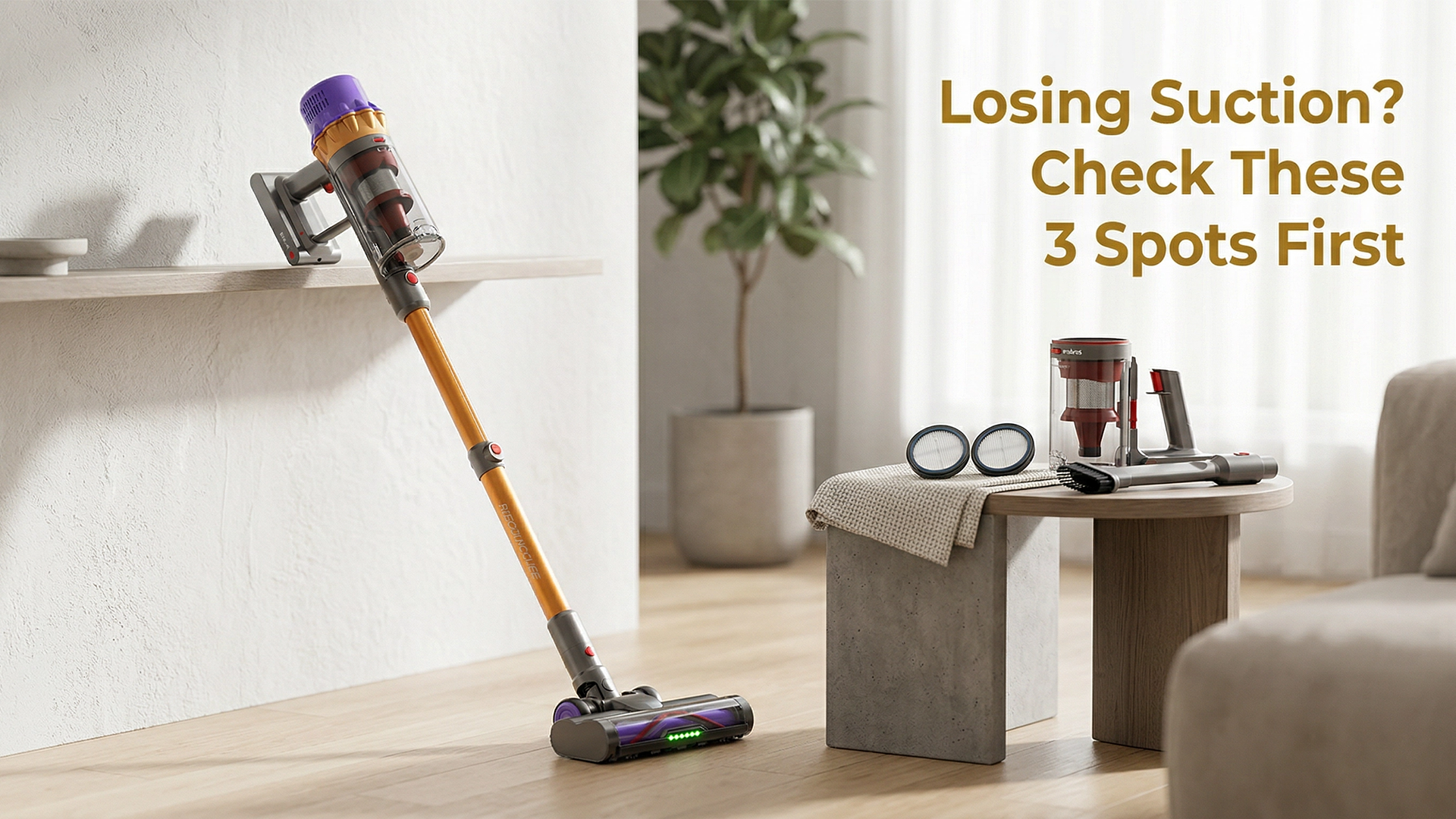
Let me paint you a picture.
It’s Saturday morning. You’ve got your coffee, you’re feeling productive, and you roll out your trusty vacuum cleaner. You hit the switch, and… womp womp. Instead of that satisfying roar that sounds like a tiny jet engine, you get a sad, wheezy hum. The roller brush is spinning, but it’s leaving behind a trail of Cheerios crumbs and dog hair like nothing even happened.
Your first thought? “Great. This piece of junk lasted exactly 13 months – one month past the warranty. Now I have to drop another three hundred bucks.”
Hold up. Take a breath. Don’t toss it in the trunk of your car and rage-return it to Target just yet.
I’ve been there. I almost returned a perfectly good Shark because I was too impatient to do five minutes of detective work. The truth is, 90% of the time, “sudden suction loss” isn’t a mechanical failure. It’s user error. And the best part? Fixing it costs exactly $0.
Before you blame the motor, check these three stupidly common spots. I’d bet my Saturday morning coffee that one of them is your culprit.
1. The Canister or Bag is Playing Hide-and-Seek
Look, I know this sounds insultingly obvious. But hear me out.
We all know vacuums need to be emptied. But “empty” means different things to different people. If you’re the type of person who waits until the dirt is packed so tight it looks like a brick of adobe, your vacuum has been suffocating for weeks. You just didn’t notice until now.
Here’s the science-y part (don’t worry, it’s short): A vacuum works on airflow. Air needs to move freely from the floor, through the wand, into the canister, through the filter, and out the exhaust. When your dust cup is packed to the brim, or your paper bag is bulging like a Thanksgiving turkey, there is literally no room for air to circulate. You’re asking the motor to suck air through a solid wall of cat litter and dust bunnies.
The Fix: Don’t just glance at it. Actually empty it. Take the canister outside (trust me on this), pop the lid, and use a stick or a butter knife to scrape out that compacted layer at the bottom. If you use bags, change it. Even if the bag feels “kind of” empty, change it. Clogged bags are the #1 killer of suction.
Pro tip: While the canister is open, smell it. If it smells like a zombie’s gym sock, that’s a separate problem, but it tells you things are stagnant. Empty it more often than you think you need to.
2. The Filter Is Choking to Death (Literally)
This is the big one. The sneaky one. The reason vacuums go to appliance heaven way too early.
Most modern vacuums have two filters: a pre-motor filter (the foam or felt one you see when you pull out the canister) and a HEPA exhaust filter (usually hiding behind a little grill near the air exit). People remember to wash the foam one maybe once a year. They forget the HEPA filter exists entirely.
Here’s what happens: You vacuum up fine dust, baking soda, drywall dust, or fireplace ash. That fine powder flies past the canister, past the foam filter, and gets stuck in the HEPA filter. Over time, that filter gets caked with a gray, oily film. Air can’t get through. Your motor is now trying to suck air through a coffee filter covered in glue.
The Warning Signs:
-
The vacuum sounds different – more of a strained whine than a roar.
-
The exhaust air feels hot. (Hot air = the motor is working too hard.)
-
You smell a “burning dust” smell.
The Fix: Pull out your user manual (or Google your model + “filter cleaning”). For most machines:
-
Foam/Felt filters: Rinse with lukewarm water only. No soap. No scrubbing. Squeeze (don’t wring) and let them air dry for 24 hours. Putting them back wet will destroy your motor.
-
HEPA filters: Some are washable. Most are not. If it’s a papery, pleated white cartridge, you can tap it against a trash can to knock off the loose dust, but if it looks gray or brown, you need a new one. They cost about $10-15 on Amazon.
Pro tip: Set a calendar reminder for every 3 months. “Wash foam filter.” Every 6 months: “Replace HEPA.” Your vacuum will thank you.
3. There’s a Secret Sock Stuck in the Hose
This is my favorite because it makes you feel like a genius when you find it.
You’ve checked the canister. You’ve washed the filters. But your vacuum still sucks as well as a toddler with a bendy straw. The problem is hiding somewhere in the tubes.
Vacuums are basically long, hollow snakes. When you suck up a sock, a hair scrunchie, a Lego piece, or – my personal nemesis – a piece of shipping tape, it doesn’t always make it to the canister. It gets lodged right at the bend of the wand or where the hose connects to the machine.
The worst part? You can’t see it. You look down the hose, and it looks dark and clear. But there’s a tiny piece of plastic film acting like a one-way valve, letting air into the wand but blocking it from coming back out with force.
How to find the clog:
-
Detach the hose from the machine.
-
Detach the wand from the floor head.
-
Take a broomstick handle, a long screwdriver, or – if you’re fancy – a drain snake. Shove it down the hose from one end.
-
If you feel resistance, you found the treasure. Push it through or pull it out.
-
The ultimate trick: If you have a leaf blower, point it at the end of the hose. I’m not kidding. The sheer force will shoot that clog out like a cannonball. Do this in your yard, not your living room.
The bendy bit: Always check the elbow joints. That’s where the floor head attaches to the wand, and where the wand attaches to the handle. Those 90-degree angles are clog magnets. Unscrew them if you can, or use a wire hanger to fish around.
One Bonus Check: The Brush Roll
Okay, I said three spots, but I’m throwing in a freebie because I like you.
Flip your vacuum over. Look at the brush roll. Is there a thousand miles of hair wrapped around it like a mummy’s funeral shroud? Hair actually acts like a brake. It tangles around the spindle, creating friction, slowing down the rotation, and killing the seal between the brush and the carpet. No seal = no suction.
The fix: Slit the hair with scissors down the length of the brush roll and peel it off. Takes three minutes. Feels weirdly satisfying.
The Bottom Line (Don’t Be Me)
A few years ago, I loaded a perfectly fine Dyson into my car, drove 25 minutes to the mall, waited in the return line, and argued with a teenager at the customer service desk because I was convinced the motor was shot.
I got home with a new model. Plugged it in. Same problem.
Turns out, the foam filter was just wet from when I “cleaned” it earlier that week. I was the problem. Not the vacuum.
So before you rage-return your machine, grab a flashlight, empty the bin, check the filters, and rod out the hose. Nine times out of ten, you’ll solve the problem in under ten minutes. Your wallet will stay $300 heavier, and you’ll feel like a home repair wizard.
And if none of that works? Then you can return it. But at least you’ll know you tried.
Got a vacuum horror story or a weird clog you’ve found? Drop it in the comments. I need to know I’m not the only one who has fished a Barbie shoe out of a hose.